


news
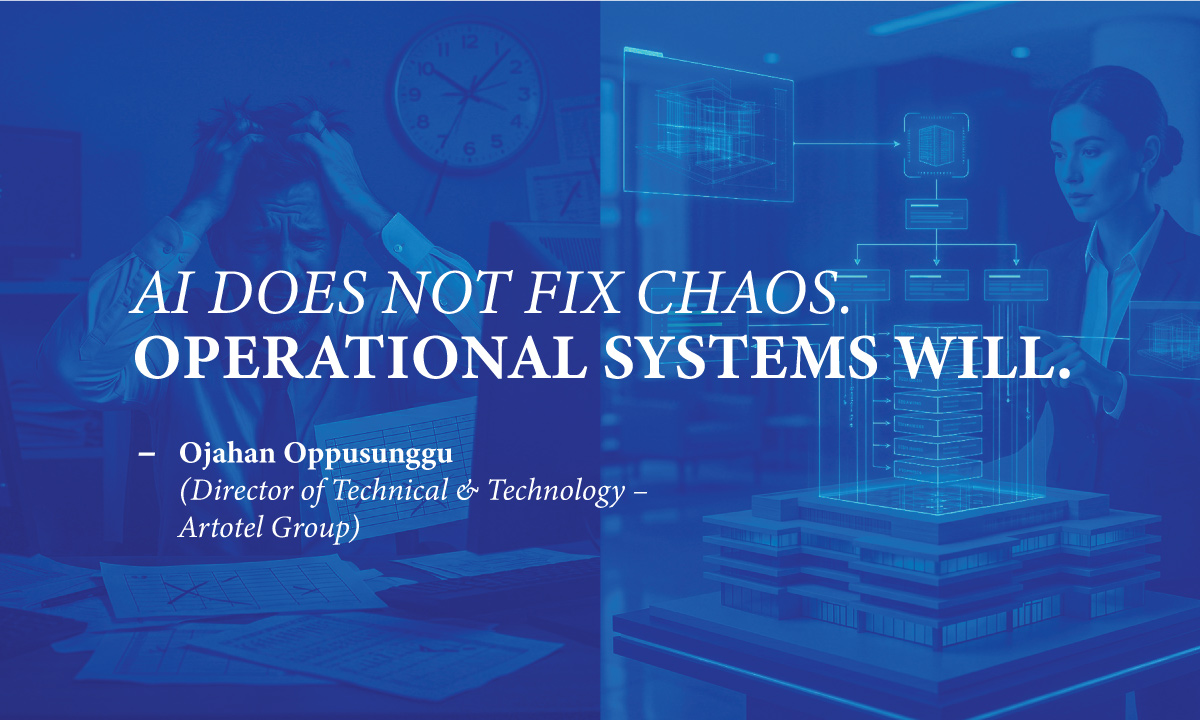
AI Won’t Fix Hotel Performance—Operational Systems Will
Why Predictable Hotel Performance Depends on Data, Governance, and Execution Discipline
Author: Ojahan Oppusunggu
Director of Technical & Technology – Artotel Group
—
Introduction
For decades, hospitality leadership has followed familiar management cycles.
Annual budgets are prepared.
Revenue targets negotiated.
Forecasts revised.
Corrective actions introduced.
Performance reviews conducted.
Yet months later, the same questions often return:
* Why is revenue below target?
* Why are forecasts repeatedly inaccurate?
* Why did costs exceed assumptions?
* Why do corrective actions arrive too late?
At the same time, another topic now dominates executive discussions:
Artificial Intelligence.
AI promises smarter forecasting, better pricing decisions, operational efficiency, and faster business insight. Hospitality organizations everywhere are now exploring AI-powered tools and digital transformation initiatives.
But perhaps these two challenges — inconsistent hotel performance and disappointing AI adoption — are not separate issues at all.
They may share the same root cause.
Not technology.
Not forecasting.
Not budgeting.
But systems.
And perhaps the industry has been asking the wrong questions.
Not:
> “How do we achieve the budget?”
Or:
> “How do we implement AI?”
But instead:
> “How do we build organizational systems capable of producing predictable performance?”
That distinction may define the next generation of hospitality leadership.
—
Hospitality Has a Predictability Problem
Most hotels still treat budgeting primarily as a financial exercise conducted once per year. In reality, budgets are rarely won or lost inside spreadsheets.
Performance is shaped by hundreds of operational decisions made every day:
* Pricing strategy
* Market segmentation
* Distribution management
* Labor productivity
* Procurement discipline
* Sales execution
* Forecast accuracy
* Commercial campaigns
* Cost control
In other words:
> Budgets are operational outcomes — not financial documents.
Industries such as construction and infrastructure understood this decades ago. Despite operating in environments with enormous uncertainty, many large-scale projects remain within budget because they rely on structured execution frameworks, including:
* Work Breakdown Structures (WBS)
* Risk registers
* Accountability matrices (RACI)
* Milestone tracking
* Variance analysis
* Continuous performance controls
Success became less dependent on intuition and more dependent on disciplined operational frameworks.
Hospitality, however, often continues operating reactively:
> Underperform → Discount rates → Revise forecast → Explain variance → Repeat.
This cycle creates management activity without necessarily creating operational control.
The problem may not be unrealistic budgets.
The problem may be inconsistent execution systems.
—
AI Adoption Is Repeating the Same Mistake
Many organizations now approach AI the same way they approach digital transformation:
Purchase software. Deploy tools. Subscribe to platforms. Launch dashboards.
But AI implementation resembles constructing a building.
Without strong foundations, sophistication eventually collapses.
Most AI readiness models follow a similar progression:
1. Establish trusted data foundations
2. Standardize and automate operational processes
3. Develop intelligent users and governance
4. Enable business transformation through AI
Yet many organizations attempt to begin at Step 4.
They pursue innovation before operational discipline.
The result is familiar:
* Expensive technology investments
* Conflicting reports and outputs
* Low user adoption
* Weak forecasting accuracy
* Leadership disappointment
Again, the issue is rarely the technology itself.
The issue is organizational readiness.
—
Data Is Everywhere. Trust Is Rare.
Hotels already possess enormous amounts of information:
* PMS transaction history
* Guest profiles
* Segment contribution data
* Pricing records
* Distribution costs
* Forecasts
* Financial statements
* Operational KPIs
* Labor reports
The challenge is not data availability.
The challenge is transforming information into trusted intelligence.
Many organizations still operate with fragmented versions of reality:
Finance interprets data differently from Operations.
Sales maintains separate assumptions from Revenue Management.
Forecasting definitions vary between departments.
AI learns from patterns.
If those patterns originate from inconsistent definitions, unreliable reporting, or incomplete records, AI simply accelerates confusion rather than insight.
This principle remains timeless:
> Garbage In, Garbage Out.
AI does not eliminate operational chaos.
> AI scales it.
—
Why Operational Discipline Matters More Than Technology
A common hospitality scenario illustrates this clearly.
A hotel misses its revenue target but still achieves GOP expectations.
At first glance, leadership celebrates profitability.
But closer examination may reveal:
* Deferred maintenance
* Delayed account payable recognition
* Frozen recruitment
* Reduced training investment
* Temporary manpower reductions
* Short-term tactical cost savings
Financial performance appears healthy. Operational quality may not be.
Similarly, when occupancy softens, many hotels react aggressively through discounting.
Rates decline rapidly. ADR weakens. Segment mix shifts. Distribution costs increase.
Soon, management loses visibility into the actual root causes.
Was performance affected by:
* Lower pricing?
* Reduced demand?
* Segment displacement?
* Distribution inefficiency?
* Market changes?
When all variables move simultaneously, diagnosis becomes difficult.
Strong operational systems create traceability.
Traceability creates clarity.
Clarity enables better decisions.
—
The Next Leadership Capability: System Architecture
Historically, hospitality leaders succeeded through operational experience, commercial instincts, or relationship management.
Future leadership may require something broader.
Not merely operator.
Not merely revenue strategist.
Not merely technology adopter.
But system architect.
A leader capable of integrating:
> Data + Governance + Project Management + AI + Accountability + Execution Discipline
This combination fundamentally changes organizational behavior.
Imagine a hotel ecosystem where:
* Historical PMS data continuously improves forecasting models
* Budget assumptions remain transparent across departments
* Variances are monitored proactively
* Risks are identified earlier
* Corrective actions happen before problems escalate
* AI explains patterns instead of replacing judgment
* Project management disciplines execution
* Leadership validates strategic decisions using trusted information
The outcome becomes larger than forecasting accuracy.
The outcome becomes predictability.
—
Predictability May Become Hospitality’s Next Competitive Advantage
Historically, hospitality competition centered around:
* Location
* Brand
* Product
* Pricing
* Distribution reach
Increasingly, competitive advantage may come from something less visible:
> The ability to produce consistent and predictable performance.
Organizations that repeatedly achieve targets are rarely operating on luck alone.
They typically possess:
* Trusted information
* Standardized definitions
* Reliable reporting structures
* Clear accountability
* Governance discipline
* Continuous monitoring
* Intelligent decision-making frameworks
These are not merely technology capabilities.
They are organizational capabilities.
Technology simply amplifies them.
—
AI Maturity Follows Operational Maturity
Hospitality discussions often position AI as the destination.
In reality, AI may function more like a mirror.
It exposes existing organizational weaknesses:
* Poor data quality
* Weak governance
* Reactive management
* Fragmented accountability
* Inconsistent execution
Organizations mature before AI succeeds — not because AI succeeds.
Which leads to a more important leadership question:
Not:
> “How do we implement AI?”
Nor:
> “How do we achieve the budget?”
But:
> “Are we building systems capable of making performance predictable?”
Because budgets rarely fail only due to inaccurate forecasts.
And AI rarely fails only because of weak technology.
Both fail when organizations lack disciplined operational systems capable of producing reliable outcomes.
—
Final Thought
The future of hospitality may belong to organizations that move beyond annual budgeting rituals — and beyond AI enthusiasm.
The organizations that lead the next era will understand a deeper principle:
> AI maturity follows operational maturity.
> Operational maturity follows system discipline.
> System discipline creates predictability.
> Predictability creates competitive advantage.
In the years ahead, competitive advantage may no longer belong solely to the hotels with the best locations, strongest brands, or largest technology investments.
It may belong to the organizations capable of producing consistent, predictable outcomes through disciplined operational systems.
Because ultimately:
> AI does not replace operational maturity.
> It exposes it.
And intelligent organizations are not built merely through technology adoption.
They are built through reliable data, disciplined execution, accountable leadership, and systems designed to produce clarity instead of complexity.
Because in the end:
> AI won’t fix hotel performance.
> Operational systems will.
—
Author: Ojahan Oppusunggu
Director of Technical & Technology – Artotel Group
Topics: Hospitality Strategy | AI in Hospitality | Hotel Budgeting | Project Management | Revenue Management | Data Governance | Leadership | Hotel Performance | Predictive Management | Digital Transformation